Must hit by slot machines have a progressive jackpot (or a feature) that is guaranteed to pay before its meter reaches a number printed on the screen, such as “must hit by $500”. The meter starts at a reset value, climbs as people play, and pays at some point before the cap. Because the progress stays on the screen between players, a must-hit-by meter is one of the few things on a slot that can change the value of the next spin.
That doesn’t make every must-hit-by machine a good bet. Most of the time the meter is nowhere near the point where it matters, and even when it is, the answer depends on more than how close the number looks to the cap.
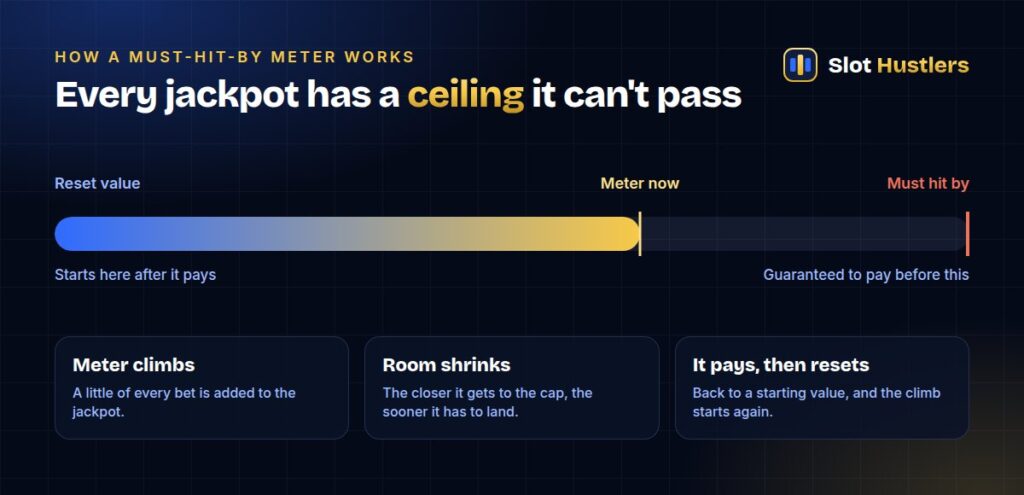
How must hit by slots work
Every must-hit-by progressive has two numbers:
- The reset (or start) value. What the jackpot shows right after it pays.
- The cap. The “must hit by” amount. The jackpot has to be awarded before the meter gets there.
Between those two numbers, a small slice of each bet (or, on some games, of each win) is added to the meter. At some point in that range the jackpot is awarded to whoever is playing.
On many of these games, the hit point is chosen at random somewhere between the reset and the cap. The Wizard of Odds describes the hit point on the games it analysed as being picked on an even spread across that range, and notes that some manufacturers’ games may behave differently. The practical effect is the same: the higher the meter climbs, the smaller the range left, and the sooner the jackpot has to land.
That is the whole appeal. On a regular slot, nothing you can see tells you anything about the next spin. On a must-hit-by game, the meter tells you how much of the range is already used up.
Must-hit-by vs regular progressive jackpots
A progressive jackpot is any jackpot that grows as people play. There are a few kinds, and they behave very differently.
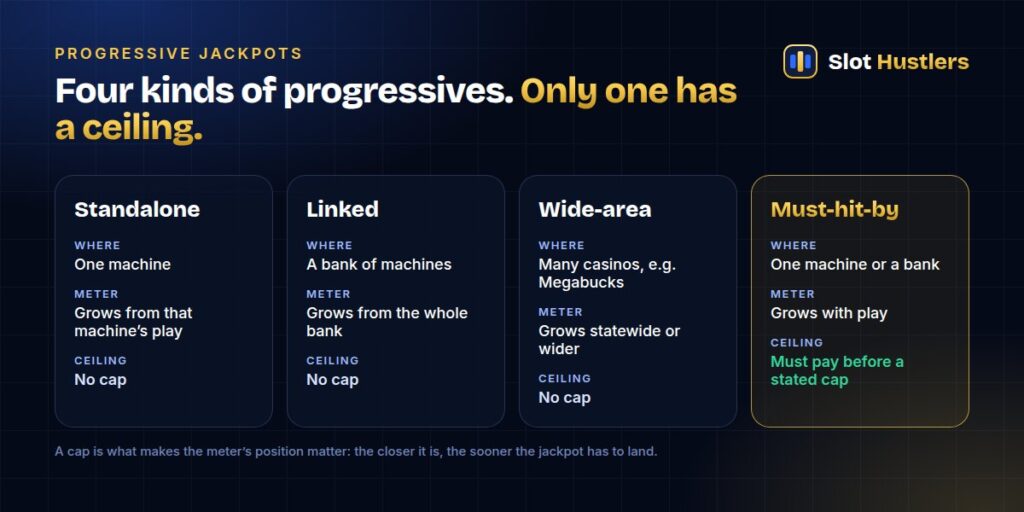
| Type | Where the money comes from | Is it guaranteed to hit by a cap? |
|---|---|---|
| Standalone progressive | One machine | No |
| Linked (local) progressive | A bank of machines in one casino | No |
| Wide-area progressive | Machines across many casinos | No |
| Must-hit-by progressive | One machine or a local link | Yes, before the printed cap |
Standalone and linked progressives
A standalone progressive grows only from the machine it sits on. A linked progressive pools play from a bank of machines, so it climbs faster and can pay to any machine in the group. On both, the jackpot is won by landing a specific combination. There is no cap, so a big meter is not “due”.
Wide-area progressives like Megabucks
Wide-area progressives link machines across many casinos. The best-known is IGT’s Megabucks, which launched in Nevada in 1986. It holds the slot record: IGT reported a $39.7 million Megabucks jackpot at the Excalibur in Las Vegas in March 2003. According to the Las Vegas Review-Journal, the jackpot resets to $10 million on every Megabucks machine in the state after it hits.
Megabucks has no must-hit-by cap. The jackpot is won by lining up the right symbols, the odds are extremely long, and the size of the meter tells you almost nothing about when it will pay.
Must-hit-by progressives
A must-hit-by progressive is different because the cap turns the meter into information. You know the jackpot has to pay before a certain number, and you can see how close it is. That persistent, visible progress is what makes these machines part of advantage play.
Must-hit-by jackpots vs must-hit-by features
The idea isn’t limited to cash jackpots. Many newer games use the same reset-and-cap design for a feature instead of a dollar amount.
- Must-hit-by jackpots: a dollar meter, often two or three of them (for example a Minor and a Major), each with its own cap. Some games keep a separate set of meters for each bet level.
- Must-hit-by features: a counter that fills up until a bonus is awarded. The counter might hold free games, wilds, reel expansions or collected symbols.
Buffalo Link is a good example of the second kind. According to Aristocrat, buffalo symbols are collected during the base game, free games and Hold & Spin, and one free feature is awarded before the collection meter reaches 1,800.
Features are harder to value than cash jackpots. A must-hit-by jackpot pays a known amount. A must-hit-by feature pays whatever the free games or bonus happen to produce, which can be small or large, so the math has to account for the average value of the feature as well as how soon it arrives.
Why a rule of thumb isn’t enough
The most common advice about must-hit-by slots is a simple rule: play when the meter is close enough to the cap. It sounds reasonable, but it leaves out most of what decides whether a machine is worth playing:
- The size of the jackpot relative to the bet. A meter that is close to a $500 cap and one that is close to a $10,000 cap are very different propositions at the same bet.
- How fast the meter moves. The share of each bet that feeds the meter controls how much you have to play to push it to the cap.
- The game’s base payback. The machine still has a house edge on every spin. The casino chooses the payback setting, and you can’t see it.
- Every other meter on the machine. Most must-hit-by games have more than one jackpot, and each one adds value.
Here is a real read that shows why. On an Ainsworth must-hit-by game with a $500 and a $10,000 jackpot, at a $10 bet and an assumed 97% base payback, the calculator gave:
| Jackpot | Return | Expected value |
|---|---|---|
| Major | 101.77% | +$2,273.80 |
| Minor | 97.05% | −$543.23 |
Same machine, same bet, same moment. One jackpot was a play and the other wasn’t. A single rule applied to “the meter” would have got one of them wrong.
This is the kind of read Slot Hustlers does from a photo: the bot identifies the game, reads each meter and runs the full expected-value math across a range of likely payback settings, instead of comparing the screen to one fixed number. You can see which games are covered on the supported games page.
What must-hit-by slots can’t do
- They don’t remove the house edge on their own. A freshly reset must-hit-by machine is an ordinary negative-EV slot.
- They don’t pay on schedule. The jackpot can land early in the range, and it can take longer than you expect to push the meter toward the cap.
- They don’t protect your bankroll. Even a positive-EV spot can lose money before the jackpot pays, and it can pay to someone else if you leave. Size your bet to what you can afford to play through.
If you want to understand why payback settings matter so much to these numbers, read What Is RTP in Slots?.
FAQ
What does “must hit by” mean on a slot machine?
It means the progressive jackpot or feature shown on the screen is guaranteed to be awarded before its meter reaches the amount printed next to it. The meter starts at a reset value and climbs as people play.
Are must hit by slots better than regular slots?
Not by default. A must-hit-by machine that has just reset is an ordinary slot with a house edge. The meter only adds meaningful value when enough progress has built up, and whether it’s enough depends on the jackpot size, the bet, how fast the meter moves and the game’s payback setting.
Is Megabucks a must hit by progressive?
No. Megabucks is a wide-area progressive linked across Nevada casinos, and its jackpot is won by landing the winning symbols. It has no cap it must hit by.
Does a must hit by jackpot always hit right before the cap?
No. On many games the hit point can fall anywhere between the reset and the cap. A meter close to the cap has less range left, which is why the number matters, but the jackpot can hit well before it.
What is a must hit by feature?
It’s the same reset-and-cap idea applied to a bonus instead of cash: a meter of free games, wilds or collected symbols that must be awarded before it reaches a set number. Buffalo Link’s collection meter, which must award a feature before reaching 1,800, is one example.
Do I need a must hit by calculator?
If you want to know whether a specific machine is worth playing, yes. The answer depends on several numbers at once, and a simple rule can call the same machine both ways, as the Ainsworth example above shows.
For players 21+. Expected value is a long-run average, and any session can lose. If gambling stops being fun, call 1-800-GAMBLER.